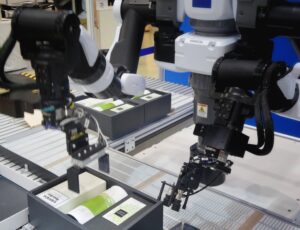
Industries’ Tryst with AMRs and AGVs
Discuss your project →Industries’ Tryst with AMRs and AGVs
Introduction
The global industrial landscape is undergoing a dynamic transformation, driven largely by the adoption of cutting-edge technologies. Central to this shift are Autonomous Mobile Robots (AMRs) and Automated Guided Vehicles (AGVs). These devices, equipped with the ability to operate without continuous human intervention, are steadily becoming integral across a multitude of sectors, spanning manufacturing, logistics, healthcare, and retail.Why Industries are Adapting to AMRs and AGVs
The pivot towards these robotic wonders isn’t arbitrary.
The industrial world’s gravitation towards AMRs and AGVs can be understood through:
- Efficiency and Productivity: In the relentless pursuit of higher outputs and streamlined processes, AMRs and AGVs offer solutions by automating tasks traditionally executed manually. Their precision and consistency promise reduced errors and increased throughput.
- Labour Challenges: As industries grapple with labor shortages or the challenges of high turnover in repetitive roles, these automated machines present a consistent and tireless alternative.
- Safety Imperatives: Workplace safety is paramount. AMRs and AGVs, by taking on potentially hazardous tasks, considerably diminish the risk of workplace accidents and injuries.
Applications of AMRs and AGVs in Various Industries
The footprint of AMRs and AGVs is expanding, signaling their wide-ranging applications:
- Manufacturing: These robotic assistants are invaluable in tasks like material handling, product assembly, and quality assurance, ensuring operations run like clockwork.
- Logistics: Within the vast expanse of warehouses and distribution hubs, these machines excel in goods transportation, storage optimization, and timely distribution.
- Healthcare: The sector benefits from these technologies through efficient patient transportation, precise medication delivery, and even tasks like sanitization and disinfection.
- Retail: The modern retail space sees AMRs and AGVs efficiently stocking shelves, managing inventory, and ensuring that products seamlessly reach customers.
Challenges to the Adoption of AMRs and AGVs
Every innovation comes with its set of hurdles:
- Initial Costs: The upfront investment for these technologies can be substantial, posing a potential barrier, especially for smaller entities.
- Infrastructure Needs: For optimal functionality, AMRs and AGVs require environments tailored to their operational needs. Retrofitting existing spaces or creating such environments can be challenging.
- Skill Demand: While these machines replace certain roles, they necessitate specialized skills for their programming, operation, and maintenance, highlighting a potential skills gap in the current workforce.
The Future and Industry Initiatives
Recognizing the transformative potential of AMRs and AGVs, industries are actively investing in research and development, often partnering with tech giants and startups alike. The aim? To refine these technologies, make them more accessible, and integrate them more deeply into daily operations. While we might still be in the early adoption phases, the trajectory is clear. As costs become more competitive and the technology more sophisticated, the reliance on AMRs and AGVs is poised to grow exponentially.The digital revolution of the Automotive Sector powered by Artificial Intelligence (AI) and Machine Learning (ML) is transforming industries across the spectrum. The automotive sector, traditionally reliant on mechanical engineering, is increasingly driven by software. Here’s a deep dive into the intricacies of how AI and ML are redefining automotive paradigms.
- Autonomous Vehicles: Beyond Human Boundaries
Self-driving cars are not mere vehicles; they’re complex integrations of software, sensors, and traditional automotive mechanics. At the core of this is AI.
- Deep Neural Networks (DNNs): These algorithms mimic the human brain. By processing data from LIDAR, radars, and cameras, DNNs can recognize objects, interpret their movements, and predict their future positions. This allows for real-time decision-making, like determining if an object ahead is a pedestrian or a paper bag.
- Sensor Fusion: Multiple sensors capture redundant data. AI combines and filters this data to create a unified perception of the vehicle’s surroundings. This redundancy is crucial for safety— if one sensor fails, another can compensate.
- Simulation and Reinforcement Learning: Given the impossibility of physically testing every scenario, AI models are trained in simulations. They repeatedly experience various driving situations, learning optimal reactions through trial and error, a method known as reinforcement learning.
- Predictive Maintenance: A Stitch in Time
Traditional vehicle maintenance is based on fixed intervals or mileage. ML offers a smarter approach.
- Anomaly Detection: By analyzing data from in-vehicle sensors, ML algorithms can detect anomalies— slight changes in vibration, sound, or temperature— that might indicate wear or impending failure.
- Regression Analysis: Machine Learning can predict when a part will likely fail by analyzing historical data and finding patterns between various factors like driving habits, environmental conditions, and component wear rates.
- Smart Manufacturing
The production line is being reimagined with AI at its core.
- Visual Inspection Systems: AI-powered cameras can detect minute defects on parts, ensuring only top-quality components are used. These systems can detect issues beyond human capability, like microscopic cracks or subtle paint discolorations.
- Optimization Algorithms: Machine learning can analyze production line data to detect inefficiencies. For example, if one robot arm operates slower than others, the entire line’s speed can be adjusted to eliminate bottlenecks.
- Personalized User Experience
Cars are transforming into personalized spaces, adapting to individual drivers.
- Natural Language Processing (NLP): Advanced in-car voice assistants now understand context and sentiment, allowing drivers to communicate more naturally and intuitively.
- Driver Monitoring: Cameras equipped with AI can monitor drivers, checking for signs of drowsiness or distraction and alerting them accordingly. Over time, the system learns the driver’s habits, adjusting alerts to be more effective and less intrusive.
- Traffic Management and Smart Cities
AI is not just changing vehicles but also the infrastructure they operate in.
- Dynamic Traffic Light Control: By analyzing real-time traffic data, AI can adjust traffic light timings to optimize flow, reducing congestion.
- Traffic Prediction Models: ML can predict traffic hotspots based on historical data, time of day, and events in the city. This allows for dynamic route suggestions in navigation systems, directing drivers away from potential congestion.
Conclusion
The convergence of AI and ML with automotive technology is forging a new era of transportation. It’s a synergy of software and hardware, creating vehicles that are safer, more efficient, and attuned to their drivers’ needs. As we accelerate into this future, it’s clear that the very essence of driving and vehicle ownership is being redefined.
Share :
Facebook Twitter LinkedIn